Tier-1 Measurement or OTDR. Choosing the Right Method for Fiber-Optic Acceptance
A recurring conflict appears in many fiber-optic projects. An OTDR is used for the acceptance of a fiber link, even though the standards clearly require a Tier-1 measurement. The supposedly fast quick check produces results that are neither standards-compliant nor reliably interpretable. Modern fiber installations operate with tight tolerances. This is precisely why choosing the correct measurement method is essential.
What Tier-1 Measurement Actually Delivers
Tier-1 measurement is based on OLTS testing (Optical Loss Test Set). It determines the insertion loss of a link from end to end. It evaluates the entire link, including all connectors, splices, and fiber attenuation. The result is compared with the calculated loss budget according to ISO/IEC, EN, and TIA. The measurement value is unambiguous, as is the outcome. Pass or fail. This makes Tier-1 measurement the only standards-compliant acceptance method.
What an OTDR Measures and Why It Does Not Replace but Complements Tier 1
An OTDR generates a graphical trace of the link. It displays events such as splices, bends, reflections, or breaks at their exact location. This makes it ideal for analysis and troubleshooting. But it does not provide a meaningful assessment of the total insertion loss. Dead zones, reflections, and averaging algorithms distort the end-to-end value.
An OTDR can determine total loss only if the measurement is performed with launch and tail fibers. In practice, these are often omitted to reduce cost. Deviations from the Tier-1 certification become especially significant in multimode. OTDRs operate exclusively with laser light, whereas Tier-1 measurements require LEDs to ensure uniform light distribution and reproducible results. In addition, connector requirements defined for Tier 1 are often applied inconsistently during OTDR testing.
And let’s be honest. Do you know whether your OTDR launch fibers actually meet reference quality?
This is why OTDR testing can never replace Tier-1 insertion-loss measurement.
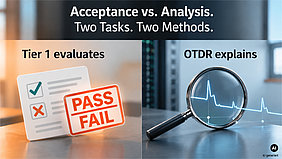
This comparison clearly shows why both methods are important but do not serve the same purpose.
Practical Example. How Tier 1 and OTDR Work Together
A technician installs a singlemode link between two buildings.
The link includes:
• 180 meters of fiber
• 2 connectors at the ends
• 2 splice-on pigtails at the ends
Step 1. Acceptance with Tier 1
The measured insertion loss exceeds the calculated budget.
Result. Fail. The link fails. The OLTS measurement provides no further detail. It only shows that the link is outside tolerance.
Step 2. Analysis with OTDR
The OTDR shows elevated loss immediately after one connector. The position is clearly identifiable. The cause is a contaminated ferrule. Cleaning is performed.
Step 3. Verification
First, an OTDR check confirms a clean event trace. Then the OLTS measurement is repeated for final acceptance.
The result now lies within the budget and receives a definitive Pass.
This example illustrates the practical workflow. Tier 1 evaluates the condition of the link. The OTDR identifies the cause. Only the combination delivers fast and standards-compliant acceptance.
Checklist: When to Use OLTS. When to Use OTDR.
Use OLTS when
- acceptance according to standards is required
- a total loss budget must be evaluated
- a clear pass/fail decision is needed
Use OTDR when
- the Tier-1 measurement shows unusually high loss above the limit
- targeted fault-location is required
- the insertion loss of individual components must be evaluated
- backscatter/reflectance performance must be assessed
This distinction saves time, reduces disputes, and improves documentation.
Why Both Measurement Methods Belong Together
Tier-1 measurement answers whether the link operates within the loss budget.
OTDR testing answers why it does not.
Together, they form a complete testing process. Installers, technicians, and network operators therefore always use two device classes. OLTS for acceptance. OTDR for analysis.
Suitable NetPeppers test instruments for Tier 1 and OTDR
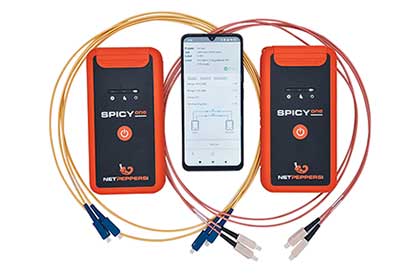
SpicyONE
A TIER 1 Fiber Certifier fully App-Controlled
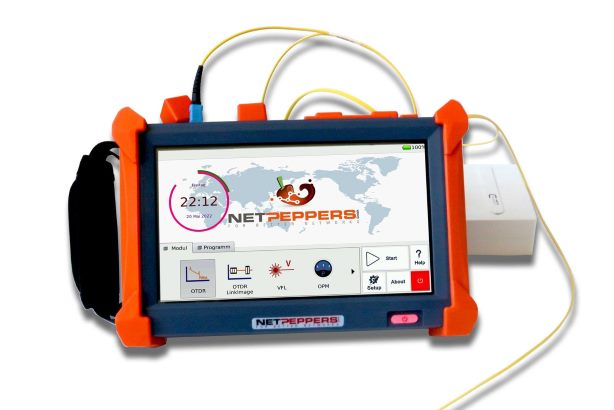
OTDR1000
Optical Time Domain Reflectometer with multifunctional test platform
Teams that clearly separate Tier-1 insertion-loss measurement from OTDR analysis achieve reliable, standards-compliant acceptance results and efficient troubleshooting. Tier 1 is the only valid method for evaluating total insertion loss. OTDR complements this with detailed event analysis.
Together, they provide clarity, reproducible results, and form a complete Tier-2 certification.
![[Translate to English:] Glasfaserinstallation](/fileadmin/images/blog/glasfaserinstallation.jpg)